| "Processed" | ||||
|---|---|---|---|---|
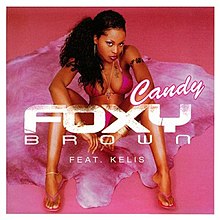 | ||||
| Single by Foxy Dark-brown featuring Kelis | ||||
| from the album Broken Silence | ||||
| B-side | "730" | |||
| Released | August 21, 2001 (2001-08-21) | |||
| Genre |
| |||
| Length | 3:45 | |||
| Label | Def Jam | |||
| Songwriter(s) |
| |||
| Producer(s) | The Neptunes | |||
| Foxy Brown singles chronology | ||||
| ||||
"Processed" is a song by American rapper Foxy Dark-brown featuring American vocalizer Kelis, released by Def Jam on Baronial 21, 2001, as the third single from her 3rd studio album Broken Silence (2001). A dance-pop and R&B track, information technology was produced by the Neptunes duo Republic of chad Hugo and Pharrell Williams, who co-wrote the song alongside Brown and Juan Manuel Cordova. Dark-brown raps on the verses while Kelis, a frequent collaborator with the Neptunes, performs the claw. The song was recorded in Virginia Beach and mixed in New York City. "Candy" premiered at the Broken Silence listening political party in June 2001, and although it did not receive an official music video, a portion of it was played in the video for the anthology track "Tables Will Turn".
The song is well-nigh cunnilingus. While this sexually explicit content marked a continuity with Brown's earlier material, information technology ready "Candy" apart from the rest of Broken Silence, which tended toward more introspective field of study matters. According to critics, the single has elements of 1980s music, dance music, and new wave music and a more pop audio than Brown's previous albums.
"Candy" received a positive response upon release and in retrospective reviews. Music critics compared information technology to music by other artists, specifically Lil' Kim, while scholars analyzed its representation of black female sexuality. In the US, the song appeared on Billboard charts, reaching the top ten on the Hot Rap Songs nautical chart. "Candy" was included on several soundtracks in the early on 2000s; it was featured in the television series Night Affections and the films Friday Subsequently Next and The forty-Year-Sometime Virgin.
Production and release [edit]
The Neptunes duo Chad Hugo and Pharrell Williams produced two songs—"Candy" and "Gangsta Boogie"—for Foxy Brown's third studio album Broken Silence (2001).[1] [ii] Billboard's Colin Finan wrote that they had become so prolific in 2001 that they had "laced nearly every R&B/hip-hop hit" that summer, including "Processed".[three] Hugo and Williams co-wrote the single with Juan Manuel Cordova and Brown, who is credited under her legal name Inga Marchand. Cordova has writing credits on five other tracks from Broken Silence.[1]
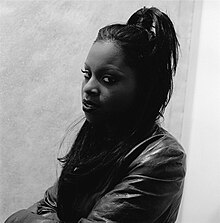
Foxy Brown (pictured in 1998) was a co-writer for "Candy".
"Candy" features vocals by Kelis, a frequent collaborator with the Neptunes.[1] [4] According to music journalist Peter Shapiro, Kelis was the duo's "diva of choice" to sing hooks on other artists' songs. Shapiro noted the diversity of her work, mentioning her contributions to music "for everyone from Foxy Brown to Noreaga".[4] "Candy" was recorded at the Main Audio Recording Studios in Virginia Beach, Virginia. The vocals were handled by David Hummel and Erik Steinert and mixed by Axel Niehaus at Avatar Studios in New York City.[1]
The song debuted at the Broken Silence listening party held in New York City in June 2001.[5] On August 21, 2001, Def Jam released "Candy" in the Us as the album's tertiary single,[6] [7] and PolyGram promoted information technology in the Britain in 2002.[half dozen] Information technology was issued as a 12-inch single and a CD single;[6] [8] the 12-inch unmarried included the song'south radio edit and instrumental and "730" as its B-side.[8] Elektra produced a pinkish vinyl tape in a limited edition.[9] To promote "Processed", Chocolate-brown performed a portion of it in the music video for her rail "Tables Will Turn".[10]
Following its release, "Candy" was featured on early 2000s soundtracks,[11] appearing in the films Fri After Side by side (2002) and The 40-Year-Former Virgin (2005).[12] [thirteen] Along with its inclusion on the 2002 soundtrack for the tv set prove Dark Affections,[fourteen] it was played in the season two episode "Some Assembly Required".[15] The song appeared on the 2003 compilation album 30 Hip Hop. AllMusic's Tim Sendra wrote that "Candy", also as Lil' Kim's "Suck My Dick" and Khia's "My Neck, My Back (Lick Information technology)", represented the "nasty females" on the album.[16]
"Candy" debuted at number 24 on the Bubbling Nether Hot 100 Billboard chart dated September 15, 2001.[17] Later the unmarried reached number 48 on the Hot R&B/Hip-Hop Songs Billboard nautical chart,[18] The Boombox'south Nadine Graham said it had "struggled its manner up" to this position.[7] The vocal also peaked at number 10 on the Hot Rap Songs Billboard nautical chart in September 2001.[19]
Music and lyrics [edit]
In comparison to Brown's previous funk-influenced albums, "Processed" has a more than pop sound,[xx] which HipHopDX 's Nomatazele further defined as dance-pop.[5] In MTV News, Shaheem Reid said it was a "sugary political party rail" that was "Castilian guitar-flavored",[21] while author Anthony J. Fonseca associated its full general style with trip the light fantastic music and refrain to pop music.[20] On the other hand, Colin Finan and the Phoenix New Times 's Bret McCabe reviewed the unmarried equally an R&B track.[3] [22] Along with these genres, "Processed" has 1980s new moving ridge influences.[2] [23] Its instrumental is built on a staccato beat ofttimes used by the Neptunes.[3] Brown raps the verses "aggressively" over the song's mid-tempo beat.[20] Finan likened her vocal style to a "sexy, husky boom", and said Kelis has a more than "loftier-pitched, childlike audio".[3]
"Candy" is near cunnilingus, as represented in lyrics such as "allow me know when you're ready to eat".[24] Finan wrote that the song is "an ode to oral sexual practice".[three] Due to this content, reviewers have likened the rail to a striptease,[25] in which Brown graphically boasts about her sexuality.[26] Although Broken Silence has a larger focus on introspective subject field matters, such every bit "The Letter" being near a suicide endeavour, critics noted it however featured sexually explicit songs, similar "Candy", as had been the case on Brown'south past albums.[27] While discussing this change in style, The Guardian 's Caroline Sullivan clarified: "Simply the sexually provocative Foxy of old isn't completely extinct."[28]
Throughout the song, Brown boasts that she tastes "just like processed". In the lyrics, "Licking my lips / And adjusting my tits and switching my hips", curriculum professor Nichole A. Guillory likened Dark-brown to a seductive stewardess instructing a lover to examine her body.[29] Chocolate-brown invites the bearding male subject to "imagine me nude, stretched out" and "nipples all out, bent over the sink",[29] merely likewise gives him a alert: "When I lay on my stomach and throw my legs back / Y'all niggaz won't know how to human activity."[23] In the tertiary verse, Brown takes on more than bureau, rapping most her self-worth.[24] [29]
Reception [edit]
Critical reception [edit]
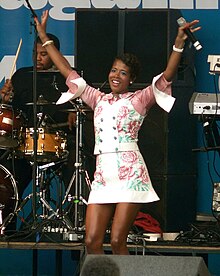
Some critics praised Kelis (pictured in 2007) for her vocals on "Candy".
"Candy" received a positive response from critics, several of whom cited information technology equally a highlight of Cleaved Silence, including Village Voice critic Robert Christgau, Steve Jones for USA Today, and the Associated Press's Latrice Davis.[30] In a review for The Dallas Morning News, Rob Clark praised the song as "undeniably catchy".[31] Writing for Spin, Joshua Clover described "Candy" as a "foreign mash of threatening, hooky, sexy, creepy, and overwhelming" vocals, and wrote that the Neptunes represented Chocolate-brown's "discreet charm".[32] In Billboard, Colin Finan said the product complimented Brownish and Kelis's voices. However, he questioned the vocal's entreatment to some audiences, specifically those of conservative radio stations, due to its sexual content.[three] In a negative review for the Phoenix New Times, Bret McCabe argued Chocolate-brown's vox was non strong enough for R&B and soul music.[22] Although critically canonical, "Candy" did not fare well with the public; Nadine Graham wrote that "the streets hated it".[7]
Retrospective reviews of "Processed" have been positive. Fuse's Jeff Benjamin included information technology on his 2014 Spotify playlist of the best female collaborations.[33] In 2019, HipHopDX 'due south Dana Scott praised "Candy" as a "pop-worthy earworm" that helped brighten the album's mood.[34] Although Graham described "Candy" as a "sugary sugariness, poppy cutting", she considered information technology shallow in comparison to the other, more personal songs in Broken Silence.[7] Kelis was besides praised in some retrospective manufactures.[eleven] [35] In 2008, The News-Press 'southward Marking Marymont said that although Kelis had "sometimes thin, even whiny vocals", she sounded better on duets like "Processed".[35] Patrick D. McDermott, writing in a 2017 article for The Fader, cited the unmarried every bit ane of her best collaborations; he described the hook as "stone-cold archetype Kelis" and "lightyears ahead of its fourth dimension".[eleven]
Scholarly analysis [edit]
"Processed" has been the field of study of scholarly analysis.[36] Scholar Doyinsola Faluyi cited Brown's appearance on the unmarried'south cover equally an example of how some black female rappers used their sexuality to promote their prototype. According to Faluyi, this was a contrast to artists like Da Deviling who adopted more than masculine styles to conform to "the dominant fashion in male hip-hop culture".[37] The lyrics were discussed by gender studies scholars Jennifer Esposito and Bettina Honey who believed Chocolate-brown's boasts nigh being the dominant sexual partner disproved psychologist Michelle Fine's theories on "sexuality as victimization". Esposito and Love remarked that Brownish's demands for oral sexual activity in the song challenge negative attitudes on sexually active women to instead "make it clear that women can want sex and can ask for pleasance".[24]
Some scholars were critical of "Candy".[24] [29] Nichole A. Guillory criticized the lyrics as objectifying blackness women equally "territories to be penetrated, occupied and ravaged by men". Guillory noted that Brown does demonstrate some agency while bragging nearly being priceless. Although she felt this moment was not enough to undo the objectification present in the other lyrics, Guillory best-selling it as an "important reminder of the ongoing struggle betwixt black women and men for control of black women's bodies".[29] Esposito and Love questioned if Brown was advocating a stereotype that "bad girls are used sexually by men, while good girls are the ones men want to marry".[24]
Reviewers accept compared "Candy" to music by other artists, specifically Lil' Kim.[24] [31] Esposito and Dearest likened the song'south candy metaphor to Lil' Kim'due south "Kitty Box" from her 2005 anthology The Naked Truth.[24] In a review of Macy Grayness's 2001 anthology The Id, Arion Berger of The Washington Post said the rail "Harry" had a "sexual boast as bold" as "Processed", which he described as "supremely nasty".[38] Writer Roni Sarig praised the Neptunes'due south production on "Candy", Beyoncé's "Piece of work It Out", and Common'southward "I Got a Right Ta" equally a "combination of classical soul, blues, and pop bundled with twenty-outset century digital mayhem".[39] In a 2020 NPR article, Stephanie Smith-Strickland wrote that "Candy" and Lil' Kim'due south 1997 single "Not Tonight" helped to institute a tendency in music explicitly about cunnilingus. She argued this influence could be heard in Khia's 2002 single "My Neck, My Back (Lick It)", which she said had "carved out a towering infinite of its own" in that area.[40]
Rails list [edit]
| No. | Championship | Length |
|---|---|---|
| ane. | "Candy" (radio edit) | iii:45 |
| 2. | "Processed" (LP version) | iii:43 |
| 3. | "Candy" (instrumental) | 3:43 |
| four. | "730" (radio edit) | 4:00 |
| 5. | "730" (LP version) | 4:12 |
| 6. | "730" (instrumental) | 4:xi |
Credits and personnel [edit]
Credits adjusted from the liner notes of Broken Silence:[1]
Recording locations
- Recorded in Master Audio Recording Studios in Virginia Beach and Avatar Studios in New York City
Personnel
|
|
Charts [edit]
References [edit]
Footnotes [edit]
- ^ a b c d e Broken Silence 2001.
- ^ a b c Seymour 2001, p. 130.
- ^ a b c d eastward f thousand Finan 2001, p. 18.
- ^ a b Shapiro 2003, p. 554.
- ^ a b Nomatazele 2001.
- ^ a b c AllMusic.
- ^ a b c d Graham 2012.
- ^ a b c WorldCat.
- ^ Whitburn 2004, p. 317.
- ^ YouTube.
- ^ a b c McDermott 2017.
- ^ Friday Subsequently Next 2002, 56:39—57:44: The songs plays when Pinky introduces Craig to a group of women during a rent party.
- ^ AFI Catalog of Feature Films.
- ^ Birchmeier.
- ^ Dark Angel 2001, 16:48—xviii:45: The song plays during a scene at a night club.
- ^ Sendra.
- ^ a b Billboard a.
- ^ a b Billboard b.
- ^ a b Billboard c.
- ^ a b c Fonseca 2019, pp. 61–62.
- ^ Reid 2001.
- ^ a b McCabe 2001.
- ^ a b c Ogunnaike 2001, p. 110.
- ^ a b c d e f grand Esposito & Love 2008, pp. 43–44.
- ^ Hall 2001, p. 22.
- ^ Jones 2001, p. 11.
- ^ Clark 2001, p. 51; Partsch III 2001, p. 22; Opie 2018
- ^ Sullivan 2001.
- ^ a b c d due east Guillory 2009.
- ^ Christgau 2001; Jones 2001, p. 11; Davis 2001, p. 18.
- ^ a b Clark 2001, p. 51.
- ^ Clover 2001, p. 133.
- ^ Benjamin 2014.
- ^ Scott 2019.
- ^ a b Marymont 2008, p. 73.
- ^ Esposito & Love 2008, pp. 43–44; Faluyi 2015, p. 447; Guillory 2009
- ^ Faluyi 2015, p. 447.
- ^ Berger 2001.
- ^ Sarig 2007.
- ^ Smith-Strickland 2020.
Citations [edit]
- "The 40 Year Old Virgin (2005)". AFI Catalog of Characteristic Films. Archived from the original on May 29, 2019.
- Benjamin, Jeff (May 7, 2014). "35 Fiery Female Collaborations From Iggy & Ariana to Mariah & Whitney". Fuse. Archived from the original on December 9, 2014.
- Berger, Arion (October iii, 2001). "Macy Grayness'south 'Id': Pure Pleasure". The Washington Post. Archived from the original on August 21, 2021.
- Birchmeier, Jason. "AllMusic Review by Jason Birchmeier". AllMusic. Archived from the original on July thirty, 2017.
- Broken Silence (Media notes). Foxy Brown. Def Jam. 2001.
{{cite AV media notes}}: CS1 maint: others in cite AV media (notes) (link) - "Bubbling Under Hot 100". Billboard. Archived from the original on Jan 22, 2020.
- Processed; 730. WorldCat. OCLC 910570258.
- "Candy [US 12"] – Foxy Brownish". AllMusic. Archived from the original on December 4, 2019.
- Christgau, Robert (September 18, 2001). "Consumer Guide: Minstrels All". The Village Voice . Retrieved March 8, 2020.
- Clark, Rob (Baronial 5, 2001). "Alpha female person? Foxy Brown hasn't earned title she claims". Arts. The Dallas Morning News. p. 7C. Retrieved August 25, 2021 – via NewsLibrary.
- Clover, Joshua (October 2001). "Show U.s.a. Your Hits". Spin. 17 (10): 133. ISSN 0886-3032.
- Davis, Latrice (July 29, 2001). "CDs by Aaliyah, Craig David, Foxy Brown and Perry Farrell". Amusement. The Herald-Palladium. Associated Press. p. 18. Retrieved Dec i, 2019 – via Newspapers.com.
- Esposito, Jennifer; Love, Bettina (2008). "More Than A Video Ho: Hip Hop as a Site of Sex Education about Girls' Sexual Desires". In Boyles, Deron (ed.). The Corporate Assail on Youth: Commercialism, Exploitation, and the Cease of Innocence. Peter Lang. pp. 27–50. ISBN9781433100840.
- Faluyi, Doyinsola (2015). "An Exploration into the Objectification of Self in Female Hip-Hop Culture as a Form of Misogyny or Empowerment". Journal of Promotional Communications. Bournemouth University. 3 (three): 446–464.
- Finan, Colin (August 25, 2001). "R&B". Billboard. Vol. 113, no. 34. p. xviii. ISSN 0006-2510. Archived from the original on December 2, 2019.
- Fonseca, Anthony J. (2019). Listen to Rap! Exploring a Musical Genre. ABC-CLIO. ISBN9781440865671.
- "Foxy Chocolate-brown - Tables Volition Turn ft. Baby Cham". Def Jam. June 16, 2009. Archived from the original on August 9, 2017 – via YouTube.
- Graham, Nadine (March 13, 2012). "Deaf History Month 2012: Foxy Brown Suffers Loss, Bounces Back Video". The Boombox. Archived from the original on March nine, 2017.
- Guillory, Nichole A. (2009). "(A) Troubling Curriculum: Public Pedagogies of Black Women Rappers". In Malewski, Erik (ed.). Curriculum Studies Handbook – The Side by side Moment. Taylor & Francis. pp. 227–245. doi:10.4324/9780203877791-19. ISBN9781135857653.
- Hall, Rashaun (July 28, 2001). "Reviews & Previews". Billboard. Vol. 113, no. 30. p. 22. ISSN 0006-2510. Archived from the original on December two, 2019.
- "Hot R&B/Hip-Hop Songs". Billboard. Archived from the original on November 19, 2020.
- "Hot Rap Songs". Billboard . Retrieved November 19, 2020.
- Jones, Steve (July thirty, 2001). "Rap/R&B". Us Today. Archived from the original on August iii, 2001. Retrieved August 21, 2021.
- Marcus Raboy (director) (2002). Fri Subsequently Next (Film). New Line Movie house.
- Marymont, Mark (March 26, 2008). "New collection features Ashford & Simpson's biggest hits". Primo Picks. The News-Press. p. 73. Retrieved December 1, 2019 – via Newspapers.com.
- McCabe, Bret (Baronial 2, 2001). "Foxy Brown". Phoenix New Times. Archived from the original on June 22, 2004.
- McDermott, Patrick D. (November 14, 2017). "10 perfect Kelis collaborations". The Fader. Archived from the original on December 25, 2017.
- Nomatazele (Apr 23, 2001). "Foxy Brownish Comes Dorsum Hard on Cleaved Silence". HipHopDX. Archived from the original on April 30, 2001. Retrieved Baronial 21, 2021.
- Ogunnaike, Lola (Baronial 2001). "Nighttime Angel". Vibe. 9 (8): 109–110, 112. ISSN 1070-4701. Archived from the original on December 2, 2019.
- Opie, David (August 20, 2018). "Why Foxy Brown Will Always Be the Illest". Highsnobiety.
- Partsch Three, Raymond A. (December 28, 2001). "Within View: Best Albums of 2001". Inside View. The Town Talk. p. 22. Retrieved December one, 2019 – via Newspapers.com.
- Reid, Shaheem (Apr 23, 2001). "Foxy Returns to Street With Broken Silence". MTV News. Archived from the original on July 11, 2003.
- Sarig, Roni (2007). Tertiary Coast: Outkast, Timbaland, and How Hip-Hop Became a Southern Thing . Da Capo Press. ISBN9780306816475.
- Scott, Dana (August 28, 2019). "The 20 Best Rap Albums Of All Time ... From Artists Who Only Happen To Be Women". HipHopDX. Archived from the original on December 1, 2019.
- Sendra, Tim. "AllMusic Review past Tim Sendra". AllMusic. Archived from the original on September 23, 2017.
- Seymour, Craig (July 2001). "revolutions". Vibe. 9 (seven): 129. ISSN 1070-4701. Archived from the original on February xiv, 2018.
- Shapiro, Peter (2003). Buckley, Peter (ed.). The Rough Guide to Rock . Rough Guides. ISBN9781843531050.
- Smith-Strickland, Stephanie (August 3, 2020). "The South Got Something To Say: A Celebration Of Southern Rap (2000–2004)". NPR. Archived from the original on November 15, 2020.
- Sullivan, Caroline (July 26, 2001). "Just don't call me a wuss". The Guardian. Archived from the original on May 10, 2014.
- Whitburn, Joel (2004). Joel Whitburn Presents Top R & B/hip-hop Singles, 1942–2004. Record Research Incorporated. ISBN9780898201604.
- Writer: Marjorie David. Managing director: Bryan Spicer. (Dec 7, 2001). "Gill Daughter". Dark Angel. Season ii. FOX.
DOWNLOAD HERE
Posted by: moodytinur1960.blogspot.com
Post a Comment