A Short History Of Financial Euphoria Pdf Download
7 min read ⌚
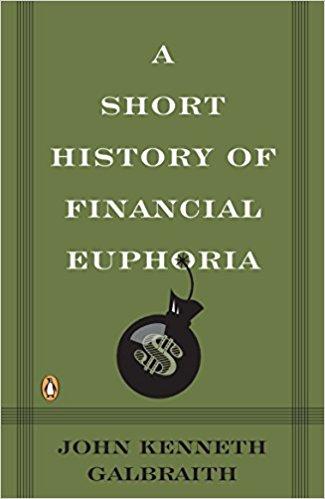 Ready for a new speculative chimera?
Because equally John Kenneth Galbraith'south " A Brusque History of Financial Euphoria" demonstrates, if there's one thing history has taught us information technology's that there will surely be one very soon.
Read ahead to find out why.
Who Should Read "A Short History of Financial Euphoria"? And Why?
In "A Short History of Financial Euphoria," John Kenneth Galbraith offers "dourly irreverent analyses of fiscal debacle from the tulip craze of the seventeenth century to the contempo plague of junk bonds ."
Chances are you'll forget the origin and the effects of all of them in the blink of an heart, which will betrayal you lot to the manipulative schemes of charlatans and cons in no time.
Which is why it's all just necessary to non only read, but as well constantly reread Galbraith's 100-page archetype.
 About John Kenneth Galbraith
John Kenneth Galbraith was a Canadian-born economist and diplomat, i of the leading proponents of American liberalism of the 20 th century.
A long-time Harvard faculty member and professor, Galbraith served in the administrations of four American presidents (Roosevelt, Truman, Kennedy, Johnson).
One of the few people to receive both the Medal of Freedom and the Presidential Medal of Freedom, Galbraith was Usa's Ambassador to India nether Kennedy and a widely respected public intellectual for the duration of the Common cold War.
A prolific author, he wrote numerous books, including a few successful novels. His trilogy on economic science – "American Capitalism," "The Flush Society" and "The New Industrial Country" – is withal hotly debated and thoroughly analyzed .
"A Curt History of Financial Euphoria PDF Summary"
There is nada in economic life," writes John Kenneth Galbraith near the terminate of his "Curt History of Financial Euphoria," then willfully misunderstood as the bang-up speculative episode.
And this, even though on the face of it, everything should be quite plain and elementary.
It all starts with a bidding war over some asset a few people believe is so rare and important that its value should only increase in the futurity.
That's, after all, the basic economic rule: when supply is low, and demand is great, prices rise .
Add together to this the yearning desire of many people to become rich overnight, and you lot get a recipe for disaster!
Because before long enough, investors join in .
Why should they not?
It's their job to get the near out of anything, and bubbling are the perfect way for them to earn some money.
And since they are usually the earliest players, they actually practice – and they do information technology big time!
Of class, these investors are not exactly humble people, and so they offset tooting their own horns, and soon even more people showtime investing in the asset the price of which, in the concurrently, has blown ridiculously out of proportions.
The scary matter is that in this second group of people there are unremarkably even quite a few intelligent analysts who are aware that at some point in the future this bubble must burst, only who, however, expect to be able to accept their money back before that happens.
Some practise. Most don't.
And when the inevitable happens – the market place crash – many lose substantial amounts of money; many more than lose admittedly everything.
The strange thing: in a decade or and so, financial euphoria strikes once again .
Why?
In the opinion of Galbraith, it is because of several unchanging factors.
Since these are probably the well-nigh of import insights of his volume but are mostly scattered through brilliant historical analyses of many speculative bubbles, nosotros tried to systematize them and so that you tin follow them ameliorate.
#1. Short-term fiscal retentiveness
When information technology comes to coin, Galbraith says, people never seem to larn anything. "There can be few fields of human being attempt," he says, "in which history counts for and then niggling as in the world of finance."
In other words, when it comes to go-rich-fast schemes, you can fire yourself numerous times, because wanting more is part of your very human nature.
Rationality is just a annotation on the margin.
#2. The fallacious link between wealth and intellect
Most people believe that wealthy investors are, by definition, smart.
Which is why they have devised all those fancy epithets about the likes of Warren Cafe, Peter Lynch, and George Soros!
Still, since well-nigh everything that happens in life and in the markets is governed by chance , it's all but crazy to believe that some people accept plant a surefire way to earn coin.
In fact, most of the fourth dimension, they take just been lucky .
The bulk doesn't think and so.
And then, it is inclined to be the victim of Ponzi schemes and speculative bubbles.
#three. Nobody believes the pessimists
Almost every bubble comes with a Cassandra or 2.
Earlier the market crash of 1929, Paul Grand. Warburg foresaw the collapse and the low, but his warnings fell on deaf ears, with the public challenge that he (a Jew) was "sandbagging American prosperity."
Most wanted to believe Irving Fisher who famously proclaimed that the "stock prices have reached what looks like a permanently high plateau."
Just a few days earlier the marketplace crashed.
#4. Anybody chooses to ignore the real reasons
Charles Mackay, in his remarkable 1841 classic " Extraordinary Pop Delusions and the Madness of Crowds" (a defining influence on Galbraith's volume which thoroughly recounts its three chapters), commenting on the South Sea Company bubble, writes thus:
[In the autumn of 1720,] public meetings were held in every considerable town of the empire, at which petitions were adopted, praying the vengeance of the legislature upon the South Sea directors, who, by their fraudulent practices, had brought the nation to the brink of ruin. Nobody seemed to imagine that the nation itself was as culpable as the S-Sea visitor. Nobody blamed the credulity and avarice of the people-the degrading lust of gain…or the infatuation which had made the multitude run their heads with such frantic eagerness into the net held out for them by scheming projectors. These things were never mentioned.
The truth is – these things never are.
Even though:
#5. Bubbles are an inherent part of the market
Speculation is function of the marketplace, and it will always be that way.
Contrary to what many will say, the market is non infallible, since humans are not infallible as well.
Regulations tin help, simply even they tin't contain mass euphoria and gullibility.
And then, as long every bit there are people and markets, at that place volition be bubbling every bit well.
Key Lessons from "A Curt History of Financial Euphoria"
1. People Suffer from a Brusque-Term Fiscal Memory
2. Believe the Pessimists – for Your Own Sake
3. Bubbles Are Inherent Part of the Costless-Enterprise Organisation
People Endure from a Short-Term Fiscal Memory
When it comes to money, people tend to forget everything, including the most disastrous financial crashes in but a few decades.
That's why it'south too optimistic to hope that people will ever acquire their lesson when information technology comes to speculative bubbles.
Believe the Pessimists – for Your Own Sake
Every speculative bubble comes with a Cassandra or two: a prophet of disaster whose prophecies nobody believes until it'southward too tardily.
Unfortunately, more oft than non – or, rather, for most of the people involved – they are the only ones who are actually correct.
Could it exist that the pessimists are too right in the case of, say, Bitcoin?
Bubbles Are Inherent Part of the Costless-Enterprise Organization
Markets are not perfect.
Bubbles are a office of them, and, as long as there are markets, information technology is inevitable that many people will lose huge amounts of money due to ruinous speculation.
The earlier you lot realize this, the ameliorate for you.
Like this summary? We'd like to invite you to download our free 12 min app , for more amazing summaries and audiobooks.
"A Brusque History of Financial Euphoria Quotes"
The circumstances that induce the recurrent lapses into financial dementia have not inverse in whatever truly operative manner since the Tulipomania of 1636-1637. Click To Tweet
The world of finance hails the invention of the wheel over and over again, oft in a slightly more unstable version. Click To Tweet
At that place is goose egg in economic life so willfully misunderstood every bit the smashing speculative episode. Click To Tweet
Speculation buys up, in a very practical fashion, the intelligence of those involved. Click To Tweet
In a globe where for many the acquisition of money is difficult and the resulting sums palpably insufficient, the possession of information technology in large amounts seems a miracle. Click To Tweet

Our Disquisitional Review
"Financial Euphoria" – to quote a slap-up review – is a keeper, the sort of book you'll recommend to other investors. It is brief, readable, with a statesman-similar style, nevertheless not above the heads of modest investors.
Originally, Galbraith wrote information technology every bit a alert. Unfortunately, as he explains in the Foreword to the book'southward second edition, a warning he grew to believe that has no value whatever:
In the first foreword to this volume, I told of my hope that business organization executives, the inhabitants of the fiscal earth and the citizens of speculative mood, tendency or temptation might be reminded of the way that not just fools but quite a lot of other people are recurrently separated from their money in the moment of speculative euphoria.
I am less certain than when I then wrote of the social and personal value of such a warning. Recurrent speculative insanity and the associated financial deprivation and larger destruction are, I am persuaded, inherent in the organization. Perhaps it is better that this be recognized and accepted.
Unsurprisingly, Galbraith ends his book with a depressing question: "When will come the next bully speculative episode and in what venue will it recur?"
That was 1994.
Unfortunately, we know at present the answer.
And, still – frighteningly – the question is still valid.

Acquire more and more, in the speed that the world demands.
DOWNLOAD HERE
Posted by: moodytinur1960.blogspot.com
Post a Comment